Alec Gilmore

Educator and Lecturer

Essays on Steinbeck

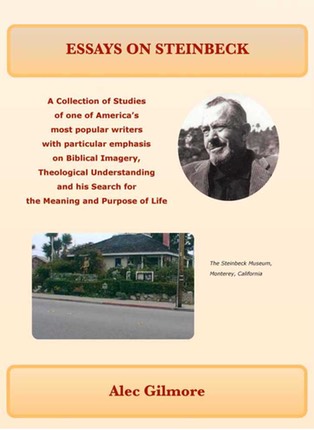
An extended visit to California gave me the opportunity to explore Steinbeck territory beginning with the Steinbeck Center in Salinas and continuing with more persistent research at Stamford and San José Universities, resulting in a series of essays on a variety of themes focusing on Steinbeck’s biblical images, his approach to religion in general and his excursions into the meaning and purpose of life.
Ten Essays on Steinbeck Themes

  • Religion in Grapes of Wrath

  • The Bible (especially Judaism) in East of Eden

  • The Holy Grail in Mallory’s 'Knights'Days in Bruton and

  • His Farewell Essay in The Winter of our Discontent

Religion

Biblical Wilderness in The Grapes of Wrath

A paper examining 'Steinbeck’s Multi-layered Use of the Biblical Image' in Michael J Meyer, The Grapes of Wrath. A Re-consideration pp 129-148, published by Editions Rodopi, Amsterdam/New York, NY 2009, xix, 908 pp. (2 Volumes) (Dialogue 7), with documentation and bibliography.

This study (in the Dialogue series) presents analyses by senior Steinbeck scholars and several new voices. Issues addressed include accusations about the novel's sentimentality, speculations about its status as a work of naturalism, and questions about its experimental structure. In addition, the language and imagery of the novel, its religious overtones, and its reputation as a radical work of art are revisited with fresh insights.

Rumour of God

A study of Steinbeck’s quest for Malory’s Holy Grail in the light of his own experience. Is the quest for biblical symbolism and allusion in Steinbeck exhausted? Or is it just beginning? Suggestions for a different way of handling it which could open up Steinbeck to a whole new range of readers.

Steinbeck's View of God

An examination of the writings of Steinbeck to explore his approach to religion through three windows, which cannot be isolated from each other and most of which turn up in nearly everything he wrote, though the emphases vary. First, biblical references, sometimes in titles, sometimes in people and sometimes in content,The Grapes of Wrath and East of Eden being the two most obvious examples. Second, biblical themes and imagery, such as the wilderness, sibling rivalry, water, and theological experiences (if not language) relating to guilt, sin and forgiveness. Third, the characters he creates and the characters whose company he obviously enjoys which tell us something about the values he embraces and are a reflection of the ‘God’ who motivates him. Published [as John Steinbeck], in The Expository Times, vol 112 no 6, March 2001, pp 192-196, with documentation.

The Bible

The 'Gospel' According to Steinbeck

Steinbeck’s mother told him Bible stories from an early age which stood him in good stead when it came to writing many of this novels and stories. As he matured he showed evidence not only of knowing the stories but also of understanding them, often with quite sharp and penetrating incite, aided and abetted by his increasing awarenesss of Judaism and a friendly rabbi.

Did Steinbeck Know H Wheeler Robinson?

A paper relating John Steinbeck's understanding of Community to Wheeler Robinson's theory of Corporate Personality, clarifying the similarities and differences.

Published in Steinbeck Studies, vol 15, no 1, Spring 2004, pp 73-87, with documentation and bibliography.

Did Steinbeck have a 'Suffering Servant'?

John Steinbeck (1902-68) is best known for The Grapes of Wrath,  never out-of-print, still selling at the rate of 50,000 copies every year in the USA alone, and regarded in many USA schools as history, though he wrote 26 other novels and plays, several collections of short stories and numerous newspaper articles, and gained the Nobel Prize for literature.

Isaiah (6th century BCE) is best known for quotes such as ‘He was despised and rejected, a man of sorrows and acquainted with grief’ and ‘Surely he hath borne our griefs and carried our sorrows’, thanks largely to Handel’s Messiah which is regularly sung in churches and Concert Halls at Christmas and Easter and is regarded by many as a significant part of British culture. The chapter from which those quotes are taken however from one of four poems, familiar to mid-20th century biblical scholars as the Suffering Servant Poems (or Songs), and it is here we must begin, since the purpose of this paper is to examine possible connections between Isaiah’s Suffering Servant and Steinbeck’s close friend and mentor, Ed Ricketts.

A Steinbeck Midrash on Genesis 4:7

A paper exploring the meaning of timshol in East of Eden in the light of Steinbeck's magnum opus. Published in Michael J Meyer and Henry Veggian (eds), East of Eden. New and Recent Essays, Editions Rodopi, Amsterdam/New York, NY 2013, pp 257-288.

This study (in the Dialogue series), designed to commemorate the 60th anniversary of the novel's publication, contains critical writings from a number of literary fields, including a biographical essay, a travel essay, further essays on varied themes in Steinbeck's works, writing on critical approaches to Steinbeck and a new essay on Elia Kazan's film adaptation of the novel.

Steinbeck in England

War Correspondent, 1943

During the Second World War Steinbeck spent six months in England as a War Correspondent for the Herald Tribune. His letters and dispatches tell us much about his war experience, but what was life like in England in 1943, the fourth year of World War 2?

The Quest for the Holy Grail, 1959 

Steinbeck and his wife, Elaine, spent the summer of 1959 in England, in a tiny cottage in Bruton, Somerset, part rest cure from the pressure of American critics and part in quest of Mallory and the Holy Grail. What were their impressions of church and community, day-to-day life in Bruton, and West Country transport, and what did he absorb of Mallory and the Holy Grail in Glastonbury? I went to Bruton to find out, and on to Glastonbury and Tintagel, to retrace some of his leisure moments.

Malory’s Morte d’Arthur — Success or Failure?

This piece meditates on Steinbeck's interpretation of the American Dream, his quest for ideals in his translation of Malory, and his application of this Dream and this quest in The Winter of Our Discontent. But did Steinbeck's writing go off after failing to find the Holy Grail, or is The Winter of Our Discontent a sign that he had in fact found it, albeit not quite what he had been looking for nor what his critics were hoping he might find?

So was his quest Success or Failure — an End or a New Beginning? Did the quality of Steinbeck’s writing go off following his failure to find the Holy Grail (as some of his critics have suggested) or is The Winter of Our Discontent an indication that he had in fact found it, albeit not quite what he had been looking for nor what his critics were hoping he might find?

First published in Steinbeck Review, vol 12, no 1, 2015,  pp 74-86, with documentation and bibliography

Site Map

Related Writings

Acknowledgements

Research and Reflection as a preparation for a paper at the 2019 Baptist Historical Society Summer School, Birmingham. Thanks are due to the Baptist Historical Society for the initiative, to Anthony R Cross (especially for his contributions on Hugh Martin and Ecumenism in the Baptist Quarterly), and to Faith Bowers, archivists at Regents and Spurgeons, and the Church Times (SCM) for locating photographs.

Footnotes

  1. AC Underwood, A History of the English Baptists, Kingsgate Press, 1947, EA Payne, The Baptist Union. A Short History, Carey Kingsgate Press, London, 1958, Ian M Randall, The English Baptists of the 20th Century, Baptist Historical Society, 2005.
  2. At the Assembly in 1883, a Unitarian guest speaker, formerly a Baptist, had overstepped the mark. Spurgeon reacted strongly by refusing an invitation to address the next Assembly ‘lest he be compromised’. In 1884, Richard Glover, (‘interested in Darwin’) assumed the Presidency and in 1887 John Clifford (a man deemed by Spurgeon to be ‘unfit for the office’) became Vice President. Matters came to a head in the Down Grade Controversy, with Spurgeon’s resignation from the Union on doctrinal grounds, driven by a mixture of increasing liberalism and the fear of change. Added to that, in 1891, General and Particular Baptists came together after living apart for a couple of hundred years. By 1900 the storm had subsided but the clouds were still dark. Shakespeare came to office in its shadow which lingered, and in some respects never went away throughout the 20th century, but the issues and their intensity varied. Looking back after fifty years Ernest Payne judged it ‘an important landmark in the history of the Baptist Union’. (EA Payne, The Baptist Union. A Short History, pp 127-31. See also Phil Hill,The Baptist Revival Fellowship (1938-72). A Study in Conservative Evangelicalism, London: Apostles, 2017). The fear of a split in the Union failed to materialise. Few followed Spurgeon down the resignation road. Some saw it as a direct attack on the General Baptists but the majority saw a national organisation as central to their well-being and one view is that the Controversy actually fortified the need for the Union as it nurtured the soil for the seeds Shakespeare was about to sow.
  3. With virtually no documentation, these points have been selected in the light of what he actually did. This is not the moment to unpack what he understood by ‘gospel’ so I am content to interpret it simply as ‘good news for all people’.
  4. Developments included the Baptist Church Hymnal (1900), Publications Department and Bookshop (1902), A Revised Constitution (1903), Baptist Insurance Company (1905), Baptist Holiday Fellowship (1907), Baptist Historical Society (1908), Baptist Ministers and Missionaries Prayer Union (1908), Baptist Women’s League (1908), Baptist Commonwealth and Colonial Society (1910), Baptist Times (1910), plus abandoned plans for a Northern Baptist College (1902-03).
  5. The Statistics are staggering. With an average working man’s wages of £150 pa and 85,000 Baptist members, that was £3 pa per member.
  6. EA Payne, The Baptist Union. A Short History, p 158.
  7. In 1883 no more than 500 of the 2,000 Baptist churches had any connection with Associations. (EA Payne, ibid., p 117).
  8. EA Payne, ibid., p 10.
  9. Anthony R Cross, Baptist Quarterly 37.3, July 1997, p 135.
  10. EA Payne, op.cit., p 117.
  11. Mirfield, 1910-20, South Parade, Leeds, 1920-31, Cannon Street, Accrington, 1931-33.
  12. A Whitehead, The Rochdale Baptists 1773-1973 to commemorate the Bi-centenary of the West Street Baptist Church, Rochdale, re-published, 1998, p 36.
  13. Thanks to John Smyth and Thomas Helwys.
  14. Martin Warner (Bishop of Chichester), in a lecture to the Worthing Theological Society (November 26, 2018) on York Minister, described the York Minster open baptistry in detail and with a commentary on the significance of immersion that any Baptist would welcome.
  15. A Leading Question, Baptist Publications, c1980.
  16. First Among Equals, Southern and Oxfordshire and East Gloucestershire Associations, 1993.
  17. Challenge to Change. A Radical Agenda for Baptists, Kingsway Publications, Eastbourne, 1991.
  18. Ibid., p 189.
  19. Maybe he was hoping that something would turn up, but when it didn’t after twenty years the lack of support from most of his senior friends and colleagues telling him the denomination was not with him was too much for him to take, leading to a nervous breakdown and early retirement. (AC Underwood, op.cit., pp 248-55).
  20. Recognised as the forerunner and ‘birthplace’ of the Ecumenical Movement. (Ruth Rouse & Stephen Neill (eds), A History of the Ecumenical Movement, 1517-1948, Volume 1, WCC Publications, Geneva, Third Edition, 1988, pp 357, 360, 362). W Richey Hogg describes it as ‘the prototype for the worldwide, ecumenical conferences that followed’ and ‘marked the beginning of the organised Ecumenical Movement on the Protestant-Orthodox side’. (‘Conferences. World Missionary’ in Stephen Neill, Gerald H Anderson & John Goodwin (eds), Concise Dictionary of the Christian World Mission, Lutterworth Press, London, 1970, p 134). John Mott said it was ‘the symbolic beginning of modern ecumenism’ (Michael Kinnamon & Brian E Cope (eds), The Ecumenical Movement. An Anthology of Key Texts and Voices, WCC Publications, Geneva 1997, p 325.
  21. The other, also a steward, was HG Wood, son of a former BU President. (Anthony R Cross, Baptist Quarterly 37.1, January, 1997, p 35.)
  22. ‘Hugh Martin’, Baptist Handbook, 1965, p 36l, qtd in Anthony R Cross, ibid.
  23. ‘Hugh Martin (i) Publisher and Writer’, in Baptist Quarterly, 37.1, January, 1997, pp 33-49, (ii) Ecumenist, 37.2, April 1997, pp 71-86 and (iii) Ecumenical Controversialist and Writer, 37.3, July, 1997, pp 131-46. Briefly, his ‘day job’ was in educational publishing, principally through SCM, starting as an Assistant Secretary (1914-19) and retiring as Managing Director (1929-50), making his greatest mark in Ecumenism for which he received the rare award of a Companion of Honour (pp 35-36, 38-39, 43). For a summary of his involvement in Unity, and especially the Plan for Unity see also pp 76-79.
  24. The support and contribution of ME Aubrey and Gilbert Laws should not be overlooked. At the second Faith and Order Conference, Edinburgh 1937, Aubrey was Chair of Section IV (‘The Church’s Unity in Life and Worship’) which produced a report strongly favouring the formation of the World Council of Churches, after which there was no looking back on the unity line. Having missed out in 1910 Baptist Tanks were now steadily arriving on Global Ecclesiastical Territory and (thanks to EA Payne and others) Baptists were determined to remain involved in the action. Similarly Gilbert Laws who delivered a paper at the 1934 Baptist World Congress, on ‘Baptists and Christian Unity: What is possible?’ After briefly sketching the developments over the previous two decades, Laws focused on the four distinctive Baptist principles: conversion, believer’s baptism, the completeness of the local church, and the priesthood of all believers. Possibly a response to the Lambeth Quadrilateral of scriptures, creed, sacraments and episcopacy. Salome had not gone but had at least been marginalised. Shakespeare could turn over in his grave and go peacefully to sleep. (Anthony R Cross, ‘Hugh Martin (ii) Ecumenist’, loc.cit., p 81).
  25. An SCM collection of essays in which members of the Friends of Reunion sketched the positions of their respective denominations believing that the first step on the road to reunion was for the Churches to understand what each other stood for, focusing on mutual comprehension not compromise. ‘The Baptists’ was written by Townley Lord, who set down the common religious heritage Baptists shared with Anglicans, Quakers and the other Free Churches, and only then proceeding to the Baptist distinctives which he identified as their appeal to the Bible, the necessity of faith in Christ for Christian discipleship, and the Church as a fellowship of the regenerate, admission to which was by the immersion of believers. These, however, did not lead Townley Lord to believe that reunion was impossible, though episcopacy, State control and baptismal regeneration continued to be obstacles. (Anthony R Cross, ‘Hugh Martin (ii) Ecumenist’, loc.cit., p 80).
  26. Details in Anthony R Cross, ‘Hugh Martin (ii) Ecumenist’, loc.cit., pp 76-78, 85 n41 & n42.
  27. Anthony R Cross, ‘Hugh Martin (i) Publisher and Writer’, loc.cit., p 39.
  28. Principal, Carey Hall, from 1945, present at the Third F&O Conference, Lund 1952, WCC Evanston Assembly 1954, International Missionary Council (IMC), Willingen 1952, Ghana 1958, and following the integration into the WCC in 1961 served the Division of World Mission and Evangelism, 1961-68. Not the first accredited female Baptist minister (that was Violet Hedger, first female student at Regents and accredited 1926) but a distinguished second when women were expected to be Deaconesses. (Anthony R Cross, ‘Service to the Ecumenical Movement. The Contribution of British Baptists’, in Baptist Quarterly 38, July 1998, p 113).
  29. Anthony R Cross, ibid., pp 107-21.
  30. EA Payne, ‘John Howard Shakespeare, 1857-1928’ in AS Clement (ed), Baptists Who Made History, pp 126f.
  31. March-May, 1954.
  32. Ecumenism for Baptists was much easier in Northamptonshire than in Oxford. Once, when I mentioned Northampton to David Paton, Anglican leader and ecumenist, he said, with a twinkle in his eye, ‘I don’t like visiting Northampton. I much prefer Oxford, where the Dissenters know their places’.
  33. H Wheeler Robinson, Baptist Principles, Kingsgate Press, 1925.
  34. FC Bryan (ed), Concerning Believers Baptism, Kingsgate Press, 1943.
  35. Henry Cook, What Baptists Stand For, Kingsgate Press, 1947.
  36. AC Underwood, A History of the English Baptists, Kingsgate Press, 1947.
  37. Robert C Walton, The Gathered Community, Carey-Kingsgate Press, 1946.
  38. A Dakin, The Baptist View of the Church and Ministry, Baptist Union Publications, 1944. See also Ian M Randall, op.cit., pp 217ff and WMS West, To Be a Pilgrim. A Memoir of Ernest A Payne, Lutterworth Press, Guildford, 1983, pp 60f.
  39. ‘The Baptist Doctrine of the Church (1948)’, qtd in EA Payne,The Baptist Union. A Short History, Appendix x, pp 283-91.
  40. The Meaning and Practice of Ordination.
  41. The Doctrine of the Ministry, Baptist Union, London, 1961.
  42. Paul Tillich, The Courage To Be, Collins, London 1962.
  43. Dietrich Bonhoeffer, Letters and Papers from Prison, Collins, 1959.
  44. John A T Robinson, Honest to God, SCM, London, 1963.
  45. Pierre Teilhard de Chardin, Letters from a Traveller, Collins, London 1969.
  46. HA Williams, The Four Last Things, Mowbrays, London, 1960, God’s Wisdom in Christ’s Cross, Mowbrays, London, 1960. The True Wilderness, Constable, London, 1965.
  47. AR Vidler (ed), Soundings. Essays Concerning Christian Understanding, CUP, Cambridge, 1962.
  48. Paul van Buren, The Secular Meaning of the Gospel, SCM, London, 1963.
  49. Harvey Cox,The Secular City, SCM, London, 1965.
  50. A Gilmore (ed) The Pattern of the Church, Lutterworth Press, London, 1963, with contributions from SF Winward, Neville Clark and WMS West.
  51. A Gilmore (ed), Ministry in Question, Darton, Longman & Todd, London, 1971, with contributions from Caryl Micklem, Neville Clark and Ernest Marvin.
  52. G R Beasley-Murray, Baptism in the New Testament, Eerdmans, 1962, A Gilmore (ed), Christian Baptism, Lutterworth Press, London and Judson Press, Philadelphia 1959, with contributions from SF Winward, REO White, SI Buse, GR Beasley-Murray, DR Griffiths, AW Argyle, WMS West, DM Himbury and Neville Clark.
  53. A Gilmore, Baptism and Christian Unity, Lutterworth Press, Guildford, 1966.
  54. PW Evans, Sacraments in the New Testament, Tyndale Press, London, 1947.
  55. Neville Clark, An Approach to the Theology of the Sacraments, SCM, London, 1956.
  56. RL Child, The Blessing of Infants and the Dedication of Parents, Kingsgate Press, London, 1946.
  57. David Tennant, Children in the Church: A Baptist View, a contribution to All Generations, a Handbook for Leaders in Worship, and David Tennant, Understanding Christian Nurture, in British Council of Churches, 1981.
  58. Ronald CD Jasper (ed), Worship and the Child, SPCK, London, 1975.
  59. Michael H Taylor (ed), Baptists for Unity, 1968, with contributions from Paul Rowntree Clifford, Robert Brown, Peter Coleman, Roger Nunn and Donald Smith.
  60. Kingsgate Press, nd. The Revised and Enlarged Edition (purchased October 1947) with benefit of input from F Townley Lord and Hugh Martin.
  61. EA Payne & SF Winward, Orders and Prayers for Church Worship, Carey Kingsgate Press, London, 1960.
  62. Compiled by Alec Gilmore, Edward Smalley and Michael Walker, Baptist Union, 1980.
  63. Compiled by Bernard Green, Christopher Ellis, Rachel Harrison, Stuart Jenkins, Michael Nicholls and Tony Turner, Baptist Union and Oxford University Press, 1991.
  64. Michael H Taylor, Variations on a Theme, Stainer and Bell, London, 1973.
  65. BRF was founded in 1938 by Theo Bamber, Geoffrey King and Angus McMillan as a movement for spiritual renewal, with links to Keswick, and became a pressure group with a commitment to evangelical principles and holding the Union to the line on matters relating to centralisation, ecumenism, doctrine and liberal scholarship.
  66. BRG arrived in 1968, led by Michael Taylor, Paul Rowntree Clifford and John Nicholson, motivated by the changing theological climate and with a firm Shakespearian commitment to Christian unity, encouraging the Baptist Union to play a full part in the Ten Propositions movement then working on the Covenant for Unity. When the House of Clergy in the General Synod of the Church of England rejected the Covenant the BRG turned its attention more to local ecumenical projects with representatives to key national and regional meetings with other denominations.
  67. Mainstream was founded in 1978 by Barrington White, Raymond Brown, Paul Beasley-Murray, Douglas McBain and David Coffey, less antagonistic to the Union than BRF, less radical and ecumenical than BRG, with an eye on the future somewhere between Shakespeare and Clifford.
  68. Robert Ellsberg (ed) and Harvey Cox, A Harvey Cox Reader, Orbis Books, Maryknoll, 2016, p 65 (after 50 years of pastoral responsibility).
  69. Qtd in Harvey Cox, God’s Revolution and Man’s Responsibility, Valley Forge, Judson Press, Philadelphia, 1965, pp 15-36 and reprinted in Robert Ellsberg (ed) and Harvey Cox, ibid.
  70. Asian ecumenical thinker and layman, based in Kerala, and moderator of the WCC Central Committee,1968-75.
  71. Asian ecumenical leader of the ecumenical movement from the 40s to the 60s.
  72. For further information see The Story of Feed the Minds.
  73. Other grants included Hymnbooks for Hungarian Baptists (£8,500), Translations and Publication costs of Barclay Commentaries in Poland, Hungary and Russia (£8,500), Children’s Bible Encyclopaedia in Poland, Magazines and Journals in Hungary (£15,000), Small Printing equpiment in Bulgaria, Poland, Romania.
  74. The emphasis on ‘God’ rather than ' as’ in the last line, as in ‘what God was, the Word was’ (NEB, REB) or (the Word) ‘was the same as God’ (GNB).